What is the difference between invoices and receipts in Hungary?
Hungary has been making great efforts towards digitalizing administrative processes, including reporting sales and income. As the next step, two new IT tools have been introduced to promote paperless solutions for creating receipts. The below article will discuss receipts in Hungary, and in our next article we will talk about the new solutions.
Hungary has been making great efforts towards digitalizing administrative processes, including reporting sales and income. As the next step, two new IT tools have been introduced to promote paperless solutions for creating receipts. The below article will discuss receipts in Hungary, and in our next article we will talk about the new solutions.
Invoices and receipts in Hungary
When your Hungarian business makes a sale, this must be documented and then reported towards the Hungarian Tax Authority so the taxes payable related to the sale can be accurately calculated. The standard document for a sale is an invoice or fiscal invoice (“számla”), which includes the data of the buyer as well as the seller and the product. In Hungarian, it is also called “áfás számla”, meaning “VAT invoice”, since invoices usually contain VAT (if not, that is specifically stated on the invoice).
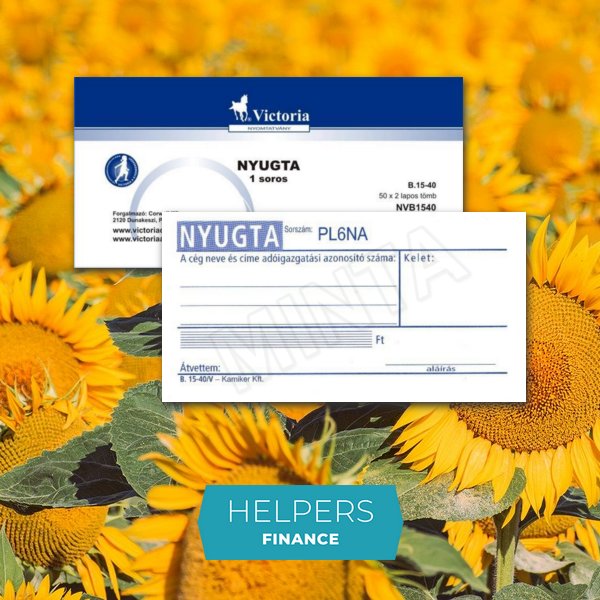
In some cases, however, sellers are allowed to make out a receipt (“nyugta”) instead of an invoice, which will contain fewer data. In line with this, the main advantage of creating a receipt is that it doesn’t have to indicate the buyer’s data and every product in detail. A receipt needs to list only the following data:
- Receipt date: the date when the receipt is created.
- Receipt number: each receipt you issue should have an individual identification number by which later you and your customer can refer to the receipt. This is not something you make up: it is already printed on each page of the receipt booklet, or automatically generated by the software you use.
- The seller’s data, including business name, seat address, and tax number (if the seller is self-employed, their registration number is also required)
- Gross total: the gross sum of the sale. Unlike on invoices, the net sum or the VAT content does not need to be indicated.
As such, creating a receipt is usually faster and altogether more convenient. At the same time, receipt creation is also more restricted, and it is possible only if:
- The customer is a natural person
- The customer is not asking for an invoice
- The total is less than HUF 900,000 (ca. EUR 2,250)
As a result, the main disadvantage of receipts in Hungary is that since they do not indicate the buyer’s data or the VAT content of the purchase, they cannot be accepted by corporate clients who would normally want to reclaim VAT after their purchases. Of course, this is an issue only in a limited number of scenarios, when corporate buyers want to make a purchase from a seller who normally creates only receipts.
Who can create receipts in Hungary?
For any business, creating an invoice for each sale is the default, although retail businesses typically create receipts with cash registers connected to the database of the Tax Authority, and make out invoices only when asked specifically. Some businesses are required to create receipts with cash registers (this depends on their NACE code). Unless this is the case, businesses can also create paper-based receipts with a receipt booklet (similar to an invoice booklet, available from stationery shops).
In line with this, currently you can find the following types of receipts in Hungary:
- Manual, paper-based receipt from a receipt booklet
- Machine generated receipt: made out with a cash register that is connected to the database of the Tax Authority
- Computer generated receipt: created in invoicing software, supposed to be printed on paper (and as such, it is considered “paper-based” whether or not it is actually printed)
- E-receipt: created with an electronic cash register, which is a piece of dedicated software (to be discussed in the next article)
Please note: up till recently, computer generated receipts were often called e-receipts. Now that e-receipts have been re-defined as receipts created by dedicated software, however, the term is restricted to this new type of receipts. More on this in our upcoming article. Watch this space.
Reporting data from receipts
Just like in the case of invoices, the data in receipts must be communicated with the Hungarian Tax Authority. Cash registers and software are connected to the Tax Authority, so reporting is automatic. The data from receipts created with a receipt booklet, however, must be manually added to the database of the Tax Authority.
When reporting data from manual receipts, you are not required to report each and every receipt separately, only the daily totals broken down according to tax content.
- If the receipts contain no VAT or their VAT content is below HUF 500,000 (ca. EUR 1,200), they must be reported within 4 calendar days.
- If the VAT content of the receipts is more than HUF 500,000 (ca. EUR 1,200), they must be reported by the end of the day after the day they were created.
Main differences between invoices and receipts
In line with the above, differences between invoices and receipts in Hungary may be summarized as you can see in the table below:
| Invoice | Receipt | |
| Seller’s data | Required | Required |
| Customer’s data | Required | Not required |
| Customer | Any customer (natural or legal person) | Only if the customer is a natural person AND they do not request an invoice |
| Sale’s data | Date List of products Totals and VAT content Gross total | Date Gross total |
| Sale’s total | No limit | max. HUF 900,000 |
| Can be issued from | Invoicing software Cash register Invoice booklet | Invoicing software Cash register Receipt-booklet ePénztárgép app |
| Expense | Can be booked as an expense | Cannot be booked as an expense |
| Reporting | One by one | In bulk, totals broken down for VAT content |
| Reporting deadline | Within 4 days for VAT content under HUF 500K, within 1 day above | Within 4 days for VAT content under HUF 500K, within 1 day above |
Need help in Hungary?
Helpers Finance provides accounting and financial services tailored to the needs of foreign owners of Hungarian businesses. If you need help deciding whether you should be issuing invoices of receipts, feel free to ask your English-speaking accountant about your options.
Was this article useful? Then read the follow-up about e-receipts here, or follow us on Facebook for more information about business and accounting in Hungary.



Contact
Get in touch today

Monday - Friday
9am - 5pm CET
Helpers Finance Kft.
Budapart Gate
Dombóvári út 27
Budapest 1117, Hungary
If you’re visiting us, please use entrance A and come to the 2nd floor.